
By Maxine Wagenhoffer, Ph.D., Director of the Hankey Center for the History of Women’s Education and Assistant Professor of History
In October 1945, Wilson College held its 75th anniversary celebration. The three-day event included a convocation on Saturday featuring a well-known guest: Herbert Hoover. Herbert Hoover served as the 31st president of the United States from 1929 to 1933; his post-presidential career was noted for his food relief efforts during World War II. Hoover’s visit occurred not too long after World War II’s formal conclusion.
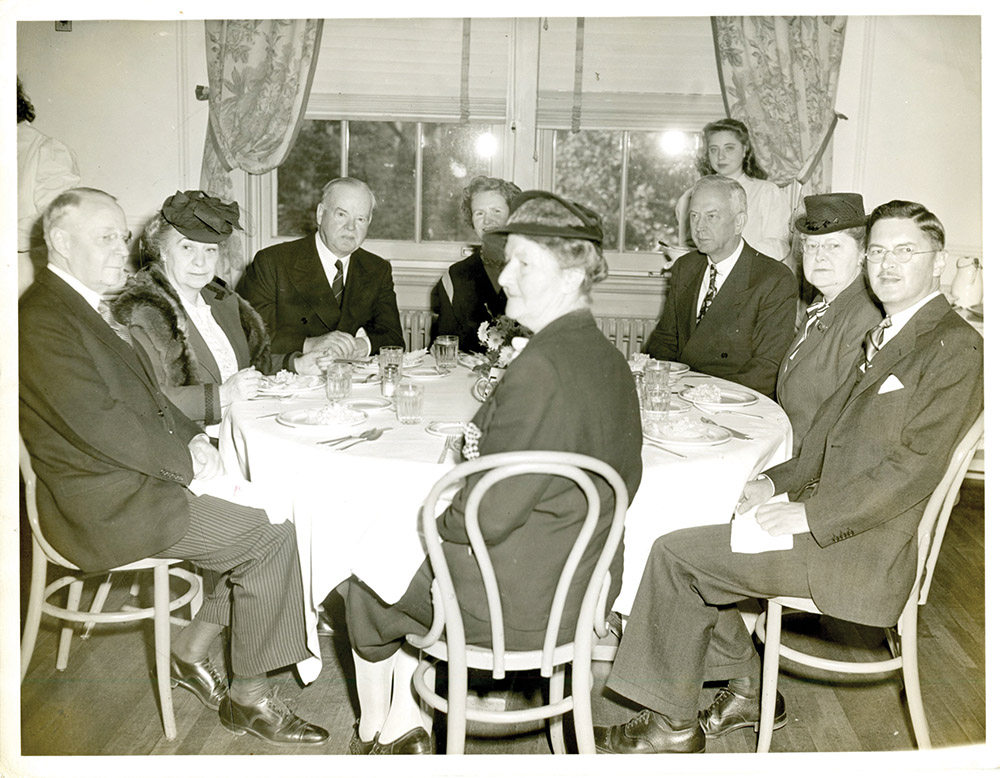
How did Wilson College land such an illuminating guest? It was not a simple path. Paul Swain Havens, who served as Wilson College president from 1936 to 1970, reached out to the former U.S. president during the summer of 1945. Havens explained that the weekend’s theme for the anniversary was “citizenship with such discussion of women as citizens as is appropriate at a woman’s college.” Havens stressed that the institution had “always been alert to the responsibilities of citizenship.” Havens wished for Hoover to focus “on the responsibilities of college trained men and women in the present and in the future.”(1) At first, Hoover expressed that he was “not making any commitments of that kind.”(2) However, on Aug. 1, Hoover wrote to Havens that he would participate in the celebration.(3) Meanwhile, journalist Eve Garrette, an alumna from the class of 1918 who was known for her book entitled A Political Handbook for Women, was close with Hoover. Garrette received a letter from Havens, prompting her to reach out to Hoover to explain that he would be received by “a most enthusiastic audience comprised of people who—if you will forgive me for saying so—worship you.”(4) Garrette, as an alumna, knew the people affiliated with Wilson College very well.
 Ultimately, Garrette’s assertion would prove to be right. The Billboard projected that the event would attract the most reporters that Wilson College ever had. The publication claimed that “every newspaper in the United States will be supplied with the news about Mr. Hoover’s speech and the events.”(5) Newspapers covered the story with anticipation. Helen Delich of the Baltimore Sun reported, “Mr. Hoover will be met by a police escort on the edge of the town. At the college campus, he will be greeted by President Paul Swain Havens and Miss Charlotte Davison, the oldest member of the faculty.”(6) Celebrating a 75th anniversary was not enough for Wilson College—hosting a former president was a cherry on top of a critical milestone.

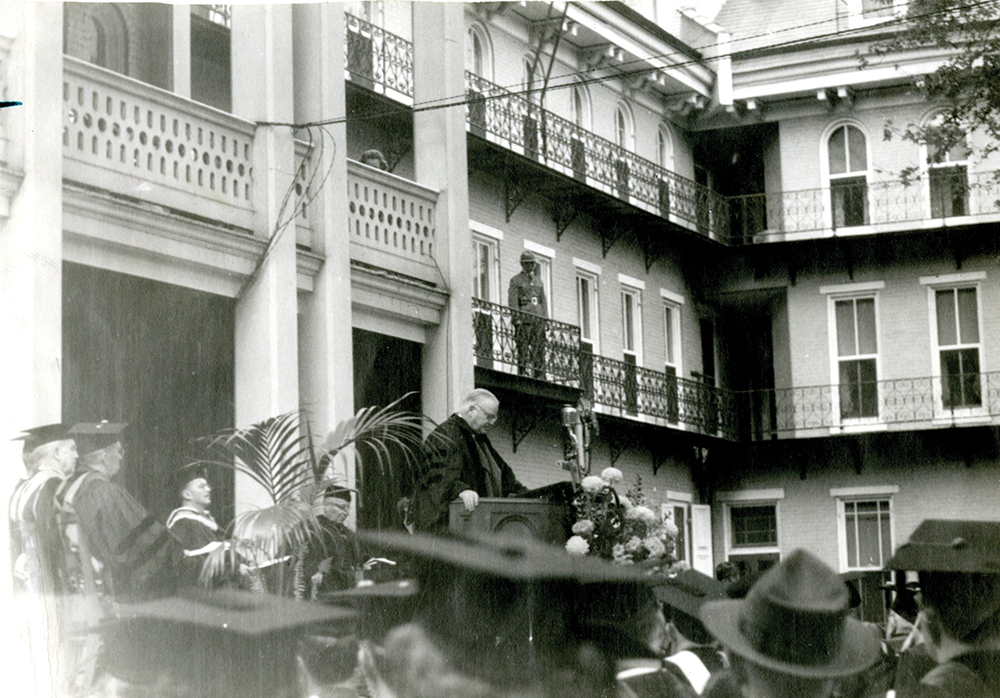
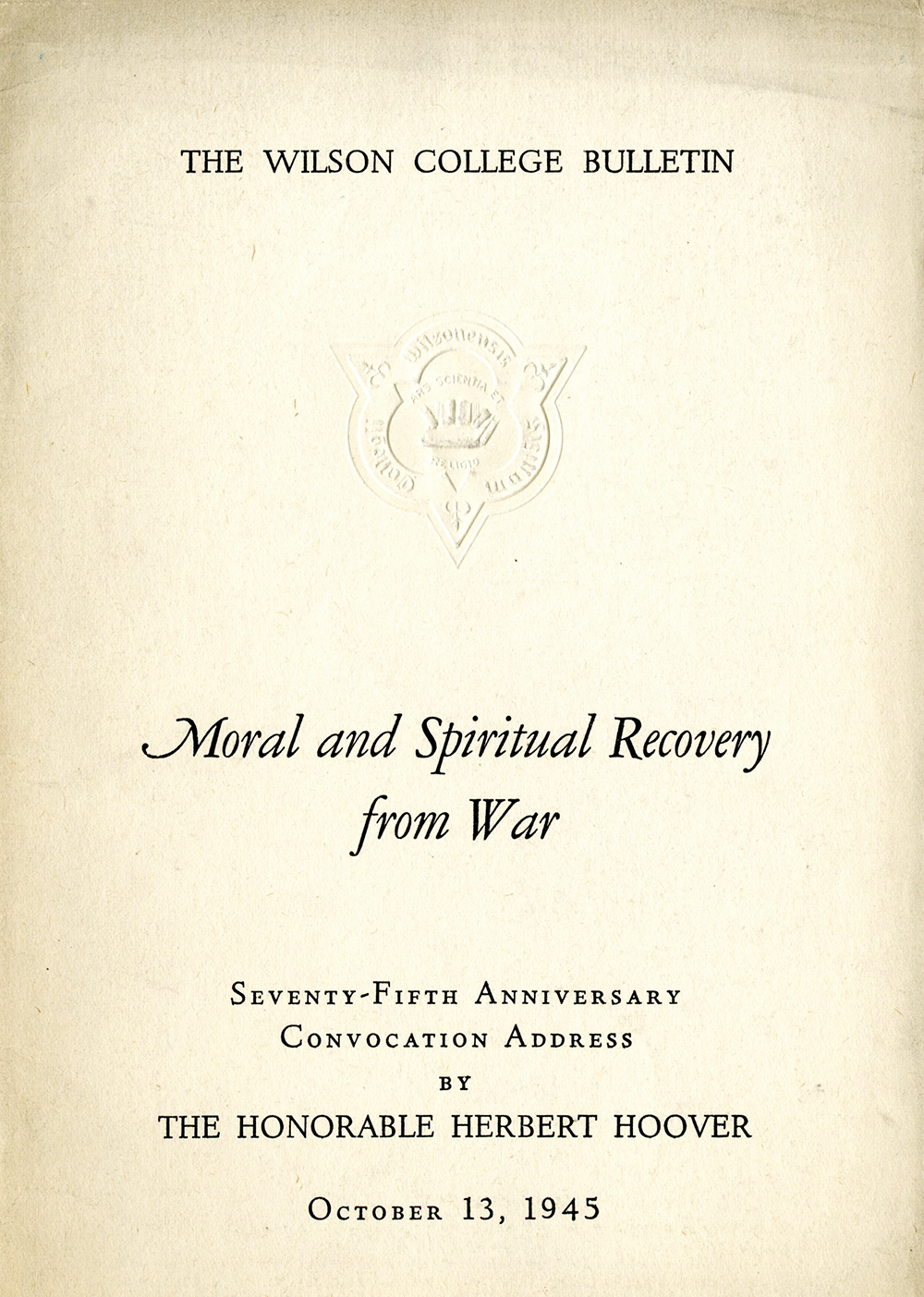
It was an epic event on Oct. 13. The Wilson Alumnae Quarterly stated that Hoover received “a royal welcome” from both the institution and the town.(7) People poured into Chambersburg. At the convocation, the governor of Pennsylvania, Edward Martin, introduced Hoover. Martin referred to Hoover as “our great Elder Statesman” and “our greatest living American.”(8) Hoover’s speech, “Moral and Spiritual Recovery from War,” highlighted the war’s impact and the need for leadership in the aftermath of the conflict. Hoover stated, “One of the riches of American life is the vast reservoir of leadership in the people. But leaders are not found like queen bees.” Hoover envisioned the U.S. education system as a conduit for the next generation of leaders. “No doubt there are men and women who rise to leadership without the full help of our colleges. But our national supply would be poor indeed if we had to depend upon this method,” claimed Hoover.(9) Moreover, for Hoover, leadership needed to be represented by all citizens. “We must have leadership in every branch of life from the shop foreman to the President,” stressed Hoover.(10) This all encompassing notion of leadership was essential for the nation to persevere.
World War II took the lives of millions of people around the globe; the United States was not insulated from the carnage—hundreds of thousands of Americans perished. Hoover recognized the toll that war took on the nation’s future. Hoover asserted, “In our lists of dead are a multitude who would have given intellectual leadership to our people.”(11) With that loss, the urge for renewal was important. Hoover emphasized that “colleges have a great obligation courageously to restore our moral and spiritual losses from the war, to renew our ideals of freedom, to regain our sensitiveness to wrong, and to provide the nation with renewed supply of trained leadership.”(12) Hoover aimed for college students, such as those attending Wilson College, to gain knowledge to lead the United States in a postwar era.
 Wilson community members were very engaged in preparing for and during the celebration. Students had signed their names on a scroll as a token for Hoover. Hoover expressed his gratitude, writing that the scroll served “as a constant reminder of a fine occasion and a wonderful group of students.”(13) Similarly, in a letter to Havens, Hoover stated, “I cannot refrain from telling you how fine an occasion last Saturday was and how much I appreciate the many courtesies extended to me by you, the college and the community.”(14) During the three-day jubilee, connections to Wilson’s long history shined. Flora Witherspoon, Wilson College’s eldest living alumna, participated. Witherspoon informed the press that she had “always admired” Hoover.(15) Additionally, Wilson College founder James W. Wightman’s daughters came to celebrate the milestone.(16)
Hoover’s speech received praise. In a letter to Hoover, Havens remarked, “From all sides have come enthusiastic comments upon your address. In every respect it was timely, thoughtful, and statesmanlike. You have pointed out to all of us, and to every educational institution, the responsibility which is ours and which we shall not seek to evade.” Letters poured in asking for copies of Hoover’s speech.(17) Newspapers throughout the country quoted from his speech. Moreover, gratitude for Hoover’s visit, along with his words,
extended beyond President Havens. Lorraine Havens, wife of President Havens, wrote to Hoover. “It was an occasion that none of us can ever forget,” she claimed while lauding Hoover for his “splendid speech.”(18) Eve Garrette also conveyed her appreciation for Hoover’s participation, stating “that the unanimous opinion is that your speech was possibly the greatest you have ever made.”(19) Even though Hoover was no longer the U.S. president, Hoover’s words still carried tremendous weight.
Herbert Hoover inspired Wilson students, their families, and the Chambersburg community in 1945. Decades later, Hoover’s emphasis on colleges shaping the next generation of leaders is as important as it was in 1945. Although Wilson College has evolved from the type of institution it was in 1945, critical threads remain the same. Wilson College has molded, and continues to mold, students into leaders, living up to the words espoused by the 31st president of the United States.
Special thanks to the staff at the Herbert Hoover Presidential Library, along with Elizabeth McIlhenney, Wilson College archivist, and Jeremiah Loyer ’27 for their assistance with this article.
1 Paul Swain Havens to Herbert Hoover, July 12, 1945, Post-Presidential Papers, Subject Files, Colleges and Universities, Wilson College, Herbert Hoover Presidential Library.
2 Herbert Hoover to Paul Swain Havens, July 17, 1945, Post-Presidential Papers, Subject Files, Colleges and Universities, Wilson College, Herbert Hoover Presidential Library.
3 Herbert Hoover to Paul Swain Havens, August 1, 1945, Post-Presidential Papers, Subject Files, Colleges and Universities, Wilson College, Herbert Hoover Presidential Library.
4 Eve Garrette to Herbert Hoover, July 16, 1945, Post-Presidential Papers, Individual Correspondence, Eve Garrette, Herbert Hoover Presidential Library.
5 “CBS Hook-Up to Carry Hoover Address Here,” Wilson Billboard, October 13, 1945, 2.
6 Helen Delich, “Wilson College Begins 3-Day Diamond Jubilee Celebration,” Baltimore Sun, October 13, 1945, 7.
7 “Community Paid Tribute to Former President,” Wilson Alumnae Quarterly (November 1945): 8. Publications (WA-16). C. Elizabeth Boyd ’33 Archives, Wilson College.
8 “Address of Major General Edward Martin, Governor of Pennsylvania, Introducing the Honorable Herbert Hoover,” Wilson Alumnae Quarterly (November 1945): 4.
9 Herbert Hoover, “Moral and Spiritual Recovery from War,” in Wilson Alumnae Quarterly (November 1945): 6.
10 Hoover, “Moral and Spiritual Recovery from War,” 5-6.
11 Hoover, “Moral and Spiritual Recovery from War,” 5.
12 Hoover, “Moral and Spiritual Recovery from War,” 6.
13 “Hoover Lauds 75th Birthday Fete,” Public Opinion, October 18, 1945, 1.
14 Herbert Hoover to Paul Swain Havens, October 15, 1945, Post-Presidential Papers, Subject Files, Colleges and Universities, Wilson College, Herbert Hoover Presidential Library.
15 “Oldest Wilson Alumna Objects to Modern Attire,” Lancaster New Era, October 12, 1945, 8.
16 Delich, “Wilson College Begins 3-Day Diamond Jubilee Celebration,” 7.
17 Paul Swain Havens to Herbert Hoover, October 16, 1945, Post-Presidential Papers, Subject Files, Colleges and Universities, Wilson College, Herbert Hoover Presidential Library.
18 Lorraine Havens to Herbert Hoover, October 16, 1945, Post-Presidential Papers, Subject Files, Colleges and Universities, Wilson College, Herbert Hoover Presidential Library.
19 Eve Garrette to Herbert Hoover, October 15, 1945, Post-Presidential Papers, Individual Correspondence, Eve Garrette, Herbert Hoover Presidential Library.
